

“There’s power in this text.”
An excerpt from The Heart of Man by Jón Kalman Stefánsson


A quick skim of our Substack’s analytics shows that a great majority of you subscribers, 92 percent, live in North America. Makes sense. That’s where we are too. But because of that I’m willing to bet that most of you 92 haven’t yet heard of Jón Kalman Stefánsson, Iceland’s greatest living writer. Which isn’t a fault of your own, it’s only within the last few years that his work has been easily available to you. But you’re still missing out if you haven’t read him yet.
Stefánsson’s books have won or been nominated for many major awards abroad, including a nomination for the International Booker Prize, and they’ve been translated into a dozen languages. He’s a bestseller not only in Iceland, but in France, Italy, Norway, Spain, and others. For a while, he was considered by literary bookies as being a strong contender for the Nobel Prize for Literature. It’s not unrealistic to say that he might still get it soon. But because, before Biblioasis, he’s never really had a North American publisher, he’s still a bit of a secret here. Fret not, we’re working on that.
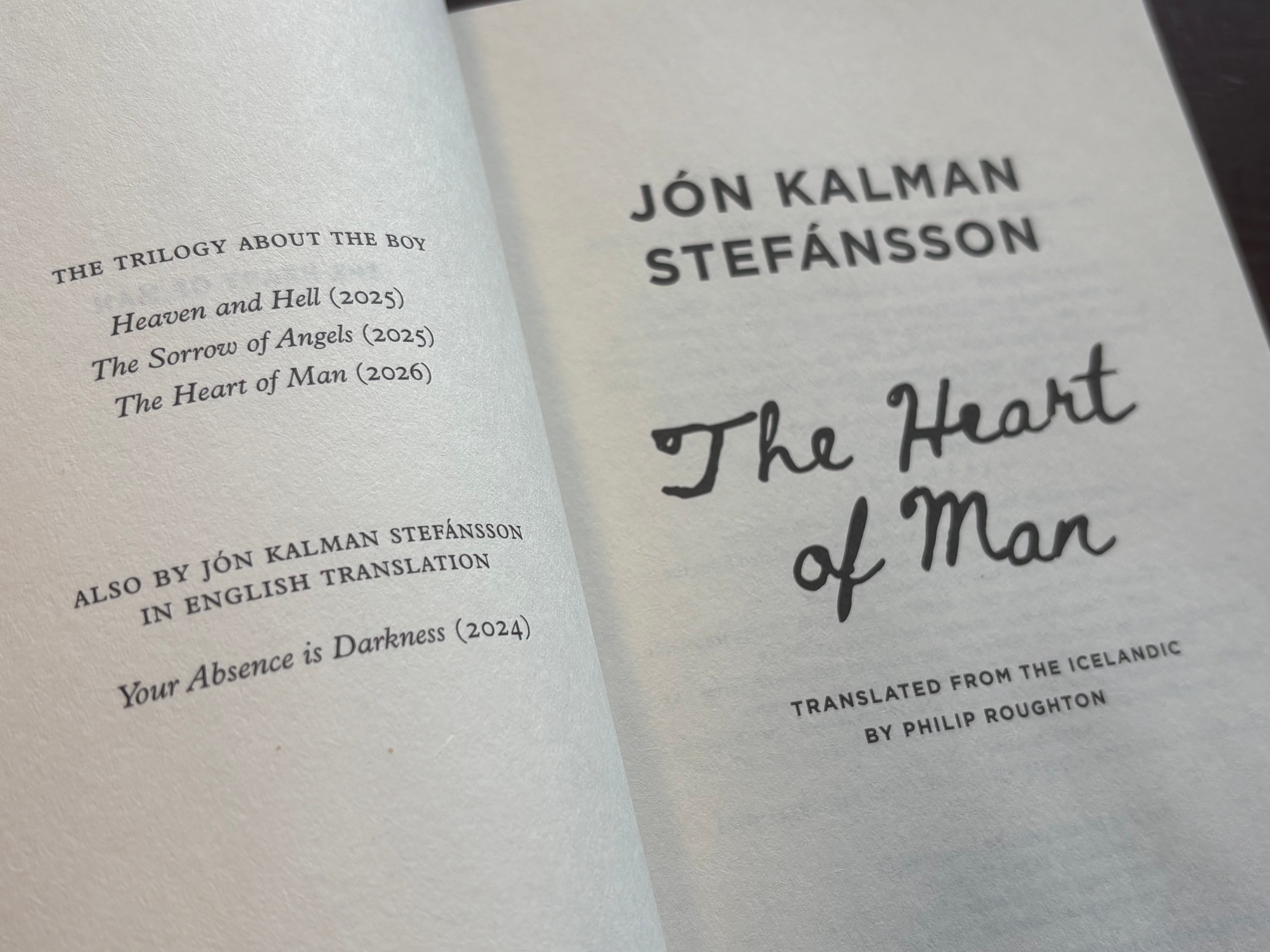
Last week we published Jón Kalman Stefánsson’s The Heart of Man, the final book in his Trilogy About the Boy (that includes Heaven and Hell, which Joy Williams called “a perfect little novel” in her review for Book Post, and The Sorrow of Angels), breathtakingly translated by the one and only Philip Roughton. This trilogy, first published in Iceland like twenty years ago, is what Stefánsson is most known for. It’s considered a classic there and many other countries already. And now you 92 can finally find them at your local bookshops or libraries.
Each book can be read and enjoyed on their own, but taken together they form a modern Icelandic saga, interspersed with comments from a chorus of ghosts, about the coming of age of a bookish unnamed boy and the inhabitants of a small fishing village in the north of Iceland, where fish are worth more than men and, shockingly, no one knows how to swim. The saga is a testament to literature and community. Like most of Stefánsson’s work, it confronts the Major Themes (life and death, love and heartbreak, man vs. nature), balancing tragedy and levity with a timeless and refreshingly sincere voice but without being annoyingly sentimental.

The first Stefánsson novel I ever read was actually Your Absence Is Darkness (Daniel Mason wrote a great review of it in the New York Times), which Biblioasis had published before my time. Here’s a little fact about me: part of the reason I said yes when I was first offered this job at Biblioasis was because I had just finished that book, and was so hooked by it in that giddy childlike-wonder kind of way that I actually agreed to move across the country to a city where I knew no one and took a job in an industry that, from reading the news and people’s Substacks every week, always seems to be dying or under threat or dead already, because I felt I needed to be near more of that feeling despite the grind (and often disappointment) that is publishing. That’s to say: reading him quite literally changed my life! How wonderful it is when an author can do that. I love that book so much, a quote from it is on the back of my business card.
Reading and rereading the Trilogy About the Boy over the last year has only confirmed for me that Stefánsson is an author whose books I will always hold dear in the same way the boy cherishes Milton or Dickens. There is a core group of characters in the trilogy, but there are also many minor ones. Stefánsson has this unique ability to display a whole life, sometimes for a character who only appears for a page or two, and makes me care deeply about them and their fate. And I cherish each and every one of them too.
In an interview for a previous Bibliophile post, Stefánsson said:
“Books were for me both, at perhaps the same time, some kind of get-away transport, and something that enlarged my life and my thoughts. And I believe that one of the main purposes of literature is namely to do all that: enlarge our life, help us to forget our self, make us see the world and our own lives in a new, often unexpected light, help us to travel around the world, get to know other times, different cultures, ideas. Those who read a lot of books, both fiction and non-fiction, and of course poetry, from all over the world, are the only ones who truly can be called cosmopolitans. And those who read little, and perhaps never foreign literature, can be easy prey for populist politicians who get their power from prejudice, discrimination, hatred and fear for those who are slightly different from them; politicians who want us to fear variety, instead of embracing it as we should do.”
Stefánsson’s work has succeeded in enlarging my life. It has moved me both physically and emotionally. And I have yet to meet anyone who hasn’t been affected by his words. Below is a short excerpt from The Heart of Man that I hope will give you a hint of what the series is all about: the enduring power of literature itself, the importance of translation, the harshness of nature, and love. And because this excerpt features a cat, here’s a photo of mine:

Ahmed,
Publicist
The complete Trilogy About the Boy series by Jón Kalman Stefánsson, translated by Philip Roughton, is now available in a bundle here on our website! Apply coupon code TRILOGY at checkout for free shipping.

Excerpt from The Heart of Man
by Jón Kalman Stefánsson, trans. by Philip Roughton
Now this sky is heavy and restless, with dark, rushing clouds. It’s summer, yet dangerous weather hangs over us. In June, which at times is so bright that it seems we can see down to the bottom of existence, to see eternity, friendly and huge in the distance. A storm, but in June; it could certainly treat us more fairly.
The wind breaks up the sea and everything that isn’t fastened down blows away: handcarts, shovels, promises; forgive me, but I don’t love you anymore, the wind tore my love from me, blew it away. Horses stand on the moors, in some places completely exposed, turning away from the wind that lashes the creatures, they let the tantrum pass over them, stare in front of them, look forward to grazing again. The rain pounds them violently, it pounds the big parlour window in Geirþrúður’s house, all four of them sit in the parlour, the boy beneath a dim lamp, you’ve got to have light to see the pages; whither went the light, who took it, bring it back, we don’t deserve this.
He has to raise his voice somewhat for the three of them to hear, because all the words have to make it across, that’s how poetry is, those are the rules, that’s how it should be, must be, writing is a war and maybe authors experience more defeat than victory, that’s just how it is, Gísli had explained, losing himself in his explanation, there was a gleam in his eye, as if he were really alive. He’d read over the five pages that the boy had translated of Mr Dickens’ story A Tale of Two Cities. It was the best of times, it was the worst of times. In this story there are few mistakes, few defeats, making the job of the translator more difficult yet happier. The boy said nothing, had the five pages in front of him, some of them heavily marked up by Gísli, the translation, the tireless work, anguish, sweat, joy, delicate movement between languages, shredded by the comments of the headmaster who talked and talked, the boy looked at the pages and the anger welled up inside him. It certainly would be nice to wad up the pages, make a big ball and stuff it into Gísli, deep into his throat, that dark tunnel. No need to let my compliments go to your head, pride is poison, Gísli said, his voice suddenly prickly. Compliments! the boy exclaimed, smiling without realising it, his eyes still on the marked-up pages; compliments, he repeated; can it be called a compliment to rip apart a work into which you’ve put all you’ve got, your heart, lungs, breath? The boy looks in astonishment at Kolbeinn, sitting next to him, his eyes closed, as if sleeping, though with his left ear turned towards them, catching every word. Yes, Gísli said, I call it a compliment to say that you’ve done quite a good job, in some places very finely done indeed, quite unusual for an uneducated person, I would call that a compliment, wouldn’t you call that a compliment from me, Kolbeinn? He raised his voice, looked over at the skipper, who said nothing, didn’t react at all. Absolutely right, Gísli muttered, you’re not here, what a wonderful talent to be able to vanish like that, a rare talent, you should give me lessons. I didn’t hear it, the compliment, I mean, the boy said apologetically, I just saw that you’d marked up everything, thought that it was no good. Is that so, did you think that? Yes. But what was that smile of yours supposed to mean, then? I was just thinking. Thinking about what, what was so amusing? Well, the boy said, embarrassed, that it would be fun to stuff the pages down your throat, at which Kolbeinn laughed, or at least emitted a noise like an old, crotchety dog that suddenly encounters something interesting, unexpectedly: a nice piece of meat, an extinguished sex drive.
The boy reads the pages, had managed to rewrite them in time, followed Gísli’s suggestions, corrections, for the most part, reads them as the rain pounds the world, pounds the house, pounds the horses, and the wind tears up the sea. He reads and tries to forget that right now the sea is breaching the embankments, flooding the earth in torrents, and to top it off there’s this gale, as if to punish us for having enjoyed the light, the gentleness of summer.

There’s power in this text, says Helga after the boy has read the five pages, these words that he found in the language and used for bridge-building so that both he and others, could seek out remote worlds, seek out life, feelings, seek out what exists in the distance of which we weren’t aware. Translations, Gísli had said, it’s hardly possible to describe their importance. They enrich and broaden us, help us to understand the world better, understand ourselves. A nation that translates little, focusing only on its own thoughts, is constricted, and if it boasts a large population it becomes dangerous to others, as well, because most things are alien to it except for its own thoughts and customs. Translations broaden people, and thereby the world. They help you understand distant nations. People hate less, or fear less, what they understand. Understanding can save people from themselves. Generals have a harder time getting you to kill if you possess understanding. Hatred and prejudice, I say to you, are fear and ignorance; you may write that down.
He did so, wrote it all down, then went up to his room and corrected the translation, and has now read it over; he read it as the storm pounded the house, the rain lashed the Village, the horses, the sheep, the earth, and turned the June light to dusk. He concludes his reading. There’s power in this text, Helga says. Yes, Geirþrúður says, yes, there’s power, and she looks at the boy. Even Kolbeinn seems to mumble something that might be interpreted as a compliment, that curmudgeon who still hasn’t let the boy into his room to view his library, four hundred books, let alone loaned him any, and although the boy hopes that that might change every single day, he would never ask out of the blue, never in his life, a man has his pride. He sits in the parlour, having accomplished something. Done what’s important, something besides pulling fish from the deep, digging up peat, stacking hay in the barn, and now, while the sky quakes with the storm and ships fight against death, the boy feels as if he matters. He who has been called a variety of names ever since his father drowned ten or twelve years ago, who forgets everything, remembers nothing, hardly notices anything, forgets and loses things. You would have lost it a long time ago, said the old women on the farm where he grew up after everyone died who was supposed to have lived, you would have lost it ages ago, that thing hanging between your thighs, if it wasn’t attached to you. He’s been called an idiot, a dolt, a muttonhead, a lout, a plonker, a milksop, a wastrel, a wimp, a scoundrel, a poltroon, scum and loafer, the language is rich with such words, it’s so easy to scold and humiliate, it takes neither talent nor intelligence, let alone courage. It could undeniably be difficult at times to believe that a physically fit urchin, later an adolescent and young man, could take so long with certain chores, could hardly remember anything that his hands were supposed to learn; he might have learned to tie a knot in the evening, and then came night and when he awoke his hands had completely forgotten how to tie it. Chances are you’re just an imbecile, an old woman said to him once, not out of malice, but rather astonishment. Yet now he’s been complimented, which is no small thing for one who’s been called many difficult names throughout his life; words have influence, they can sink into you and cause a stir, get a person to believe things about himself; to receive such a compliment, and from these women—the boy is close to sobbing. Another five pages in a week, can you manage it? Geirþrúður says, raising her wine glass to her lips, those lips that were kissed today, and that kissed; then she was alive, in the deserted valley, she existed, she burned, the birds were startled and the mountains took note of her. Yes, the boy says, convinced, confident, happy, I can manage it, there’s zeal in his eyes, while outside the storm rages and the world trembles. It would probably be safer to tie it down so that it doesn’t blow out into the darkness of space. Andrea lies in her bed in her basement room and listens to the storm, it’s not her bed, admittedly, but Geirþrúður’s, as is the entire house, she lies there and can’t sleep, tosses and turns, doesn’t know how she should lie, how she should live, the wind pounds the house, tears up the sea, which is dark and heavy and restless, even the Lagoon, which is usually calm even when breakers beat outside it, is tumultuous, and J. Andersen’s ship rolls upon it frighteningly, its hold empty.

Lúlli and Oddur had worked tirelessly, along with some others, to empty the ship’s hold of sacks, bags, barrels, and they succeeded, continual work, many hands, things are often urgent here between the mountains, life is in a rush, or, put better, people, not life itself, which simply exists, is just there, like a flower, like music, like a dagger, like sleet, an abyss, healing light. But whatever life is, extraordinary or commonplace, it was urgent that Andersen’s ship, the St Louise, be undocked. Saint Louise. We don’t know why she was made a saint, this Louise after whom the ship is named, why she deserved it, what torments she had to suffer, does a person have to suffer torments to deserve the name of saint; can’t she be happy, isn’t it difficult enough in this world, beautiful enough, noble enough? But it was urgent that the St Louise be moved from the pier, another ship was waiting on the Lagoon, laden with salt, salt is needed to salt the fish, and the St Louise needed to be unloaded in haste, yes, now the men had an opportunity to show what they were made of, work like devils and never quit; if their hands dropped off them with fatigue, they should just screw them back on. The foreman, Kjartan, was in his element, he’s a great shouter, great at goading men, sometimes they work at night, even until morning, and if someone grumbles, wants to go home, it’s fine, do as you please, but you won’t need to return anytime soon. Skúli has written pointed articles in opposition to this labour-fervency, an energetic man, that Skúli, not a stylistic adept, his sentences aren’t daggers but rather, hefty cudgels. It’s heartening that Skúli should stand up to these devils, but it’s not at all heartening to lose your job, to fall out of favour; then it’s a struggle to survive—are you supposed to watch your children starve in the summer, drop dead from cold in the winter? No, unfortunately, it’s better to swallow your pride and work, labour on as you’re ordered to do. The St Louise was emptied of everything that foreign countries have: figs, Akvavit, cotton, planed choice timber, coffee; there were even crates of apples. Oddur dexterously managed to open one without being seen, hid two apples beneath his coat, and now, as the storm tears the June light apart, howls over the houses and makes the mountains rumble, the three of them sit, Oddur, Rakel and Lúlli, at Oddur and Lúlli’s, they’ve sliced the apples and slowly eat this fruit that has drunk in the sunshine and tenderness of faraway worlds. Rakel smiles; dear God, how delightful it is to see her smile up close as the storm shakes the little house furiously, the world has turned into one continuous roar. Whence comes this savage power, now, when the month of June should be plover song over our existence?
Oddur had stopped in to see Rakel towards evening, after they’d finished unloading the St Louise; we saw what was in the offing, the darkening clouds, rising wind, a rumble or two from the mountains, as if it were too much to restrain their suppressed wrath. Oddur wanted her to join them, what with a storm in the wings, well, or at least foul weather, and he also had a little something that he and Lúlli wanted to share with her; nor is there any need for you to be alone in such foul weather. But she’s often been alone in foul weather, malicious winter storms, and she’s never been afraid, the only storm that she fears is the one in people; to be more precise, in men, which is worse, infinitely worse, when it’s not enough to dress warmly, take shelter, it penetrates you and fills you with anxiety, fear, fills your blood with a maddening drone. Rakel said nothing, of course, about the storms in men. She said, Stormy weather is just wind in a hurry, there’s little to fear. Still, Oddur said, it would be nice to have you visit, and she went with him without having meant to, without having dared to, something inside her made the decision, and Gísli watched her leave with Oddur, saw how they walked side by side. Well, now I’ll lose her, he thought, she’ll leave the basement and then there’ll be nothing more between me and the Devil, perhaps I should rent you the basement, he said to his walking stick, which was leaning against the wall by the door and naturally has no mouth, no eyes, no heart; it doesn’t matter if you give it a name, names don’t change death into life. But the three of them, Oddur, Rakel, Lúlli, eat apples, and she smiles and Oddur’s heart takes many an extra beat, while out on the Lagoon the St Louise rolls horribly.

Rolls with men and rats and the ship’s cat, which is still basically a kitten, afraid of the rats, afraid of the storm, and stays with John Andersen in the captain’s cabin. Rolls and pitches horribly, the Lagoon is unrecognisable and the wind wails in the mountains, a wail that can practically burst your head if you aren’t used to it. The crew can’t sleep, so they might as well drink, take the opportunity and get roaring drunk, cheers mates, cheers brothers, we’ve all got the sea in our veins and that’s why we’re brothers. Andersen doesn’t drink with them, he’s on the verge of falling asleep with the purring cat next to him. The storm terrified the creature, the wailing, the rolling. It’s alright, the captain mutters soothingly, we’re closer to being on land than at sea, you terrible fool, he says, smiling when the cat finally sleeps, carefree as long as it feels the hand of its master, who strokes its small head with his thumb. Charming animal, this cat, more or less a kitten, eternally happy, glancing around in search of something to play with, something that moves. Andersen had told Geirþrúður about the kitten, its joie de vivre is so abundant, he said, you should get yourself a cat. That would hardly please the ravens, she said, smiling. He looked into her dark eyes, nearly black, and felt as if he caught a sudden glimpse of those big, black birds. He reached to stroke her face, her nose, eyes, lips, reached out his hand as if to pull her up from the loneliness that he could sense so strongly that tears came to his eyes. Even now his eyes are moist, as the ship rolls and he pets the purring cat. His younger daughter gave him the cat, then nearly blind and helpless; the girl’s name is Olavia, just thirteen years old, bright and quick to laugh and a bit delicate. Olavia gave me the kitten, he told Geirþrúður, had to say it, she’s the youngest, she laughs so wonderfully, and then, before he knew it, he’d said the names of the other children, Thomas and Ivylin, both have left home. He talked, spoke of and forgot the agreement he’d made with Geirþrúður—not to speak of his family. I start to love you, Geirþrúður had said four years before, when a power stronger than the two of them began to draw them together, as soon as you behold the land rise from the sea, as soon as you behold it rise from the depths, then I start to love you, then you begin to exist. Where you come from, whoever you are there, what life you have, that doesn’t exist between us, with me you’re someone else, with me you’re mine. It was good to have it that way, easier, but no one can keep silent, in the long run, about his life, sooner or later memories rise to the surface, it’s a law of nature, even Jens had to speak, though he barely has a mouth. Captain John Andersen spoke of his children, but mostly of Olavia, followed by his wife, spoke her name. Geirþrúður said nothing, just looked up at the sky, her fingers fondled his hair, she didn’t stop him, didn’t silence him with a kiss, which is the gentlest way in the world to tell someone to hush, I shut your lips with a kiss because your words torment me. She allowed him to talk, she listened, though it hurt, maybe because this man, a foreign ship’s captain, means so much to her that it frightens her sometimes. They lay on their backs in the hollow, his head in her lap, his eyes were shut but she looked up and the sky sank into her dark eyes.
Now Geirþrúður is asleep in her big bed.
He couldn’t be persuaded to sleep with her; I’m sure I could bear having you with me tonight, Geirþrúður had said as they approached the Village, the breeze that barely stirred the blades of grass would become this storm, and now they all lie levelled, completely overcome, they have no chance, but will rise again as soon as the storm subsides, as if nothing had happened. Andersen couldn’t have stayed with Geirþrúður though he wished to, longed to fall asleep to her scent, fall asleep to her black hair, but because of the storm he had to return to his ship. The cat, the half-adolescent kitten, is glad of his presence, so big, with a strong, soothing voice, because the ship is rolling so horribly. It mewed several times in fright, but Andersen calmed it, the big hand calmed it and the cat fell asleep purring. The St Louise rolls, it rolls unnaturally, and Andersen sits up, in careless haste, forgets himself, wakes the cat, which complains a bit, opens one eye a crack, mews softly. Where is your hand? it asks, and Andersen extends his heavy arm without a second thought, soothes, comforts with gentle strokes. Something had awakened him, torn him from the sleep into which he was sinking. He strokes the cat, stares into space, at first thinks only of Geirþrúður. Simplest would be to cut all ties with her, simplest by far; it would also be more convenient for dealing with the people in this remote village, the merchants for whom he sails, their behaviour towards him changed, cooled, when he began to be drawn to Geirþrúður. But sometimes, even the simplest, most obvious course can prove impossible to take. I’m putting a stop to this now, he’s thought at times, setting sail to the north in the spring, sailing in the direction of cold and light, but as soon as he sees the land rise, emerge from the unfathomable depths, his desire grows so strong that he could kill, his longing so great that he could weep. Sometimes in the winter, as we’re sailing in the Mediterranean, perhaps, I wake up to your scent and have difficulty breathing and miss you so unbearably. It’s dangerous to miss someone, Geirþrúður had said, but smiled, smiled beautifully, smiled as if she couldn’t help it. The ship rolls. He’d lost himself in his thoughts, the longing, the lust, the love, all of it sedated his vigilance, his responsibility. The ship shouldn’t be rolling so terribly. The damned imbeciles have forgotten, or haven’t bothered, to add ballast, didn’t take the possibility of extreme weather into consideration, it being summer; no space for storms in all this light. I don’t like the look of this, Andersen mutters, spreading the covers over the cat like a child, even kissing it with a faint smile, and the cat emits a tiny whimper of bliss. Andersen sits up and perhaps it’s then that the boy looks out the window, having been unable to sleep, yet not having cared, not having the heart to do so, sat there and translated Mr Dickens, enjoyed being alive, the praise and recognition from Geirþrúður, Helga and Gísli within him like a song, and it’s impossible to fall asleep with blood singing in your veins, he sat there for four hours, then opens the curtain. What a tumult, he mutters in surprise, having hardly noticed the frenzied weather, forgotten about it, the rain that pounded the mountains, the howling wind, he sees the Lagoon between the houses and the St Louise rolling. Bloody hell, he thinks, feeling nauseous, draws the curtain, lies back down, smiles, shuts his eyes and thinks about his brother, where might he be, and how might he find out? Sleep approaches, he hears a faint rumble, a heavy echo in the mountains as a terrifying wind blasts across this speck of the world, this nook that is our universe. A violent gust, almost like an explosion, and the mountains resound over the sleeping Village. Then the deafening noise passes and for several seconds all is silent, even the rain stops falling, the drops stop and hang in the air like thousands of transparent eyes, as if the storm had finally found an outlet in the squall, and now stops, looks around to see whether it’s had any noticeable effect. I’m falling asleep, the boy thinks, I’m falling asleep in the silence, after the storm has stopped and the raindrops are no longer raindrops but transparent eyes. What the eyes see, they tell the sky.

In good publicity news:
Precarious: The Lives of Migrant Workers by Marcello Di Cintio has won the City of Calgary W.O. Mitchell Book Prize! See the announcement and video profile here.
The Passenger Seat by Vijay Khurana has won the McKitterick Prize.
The Heart of Man by Jón Kalman Stefánsson (trans. Philip Roughton) was reviewed in the Literary Review of Canada: “A forceful and intricate trilogy . . . While familiarity with those two novels enriches reading of the third, The Heart of Man is compelling enough on its own, with its lyrical story of a single summer.”
Cherry Beach by Don Gillmor was recommended as a great summer read on CBC’s The Current, and was reviewed in the Literary Review of Canada: “Gripping and beautiful . . . recalls the best of Ed McBain’s seminal 87th Precinct series, coupled with the grimy urban reality of Richard Price’s crime novels and screenplays.”
On Sports by David Macfarlane was reviewed in the Literary Review of Canada: “With a welcoming, conversational, and charmingly self-deprecating tone, [Macfarlane] walks us through the enduring conflict between loving a sport and hating the inherent frivolity of its culture.”
Alex Pugsley, author of Silver Lake, was interviewed on the Bookin’ Podcast.