

A Certain Faith
"You must go on. I can't go on. I'll go on."


On Tuesday morning I took the 5:35 train to Toronto to spend the day down in Elaine Dewar’s home office, helping the family sort through papers and ready things for a possible archive acquisition. It was strange to be down there again: though the bookshelves were a little more bare than they had been in September, her desks were as she had left them when she took a break to go on vacation last August; when she went to the hospital she never expected that she’d not be back down there again.

I put together some bankers boxes and got to work, and as I began to read and sort and label I was reminded repeatedly of her fierce dedication to what she understood to be her journalistic vocation. There were the dozens of notebooks recording the interviews that went into the making of Oblivious: Residential Schools, Segregated Hospitals, and the use of Indigenous Peoples as Slaves of Race Science, that we will be publishing later in April; the files of fact-checking, the piles of books that looked as if they’d been torn through in a rage: they were folded and scored and bent and scribbled on, though organized in piles directly related to what she was working on. There were boxes of newspaper clippings and academic research papers; the folders of freedom for information requests and her correspondence with officials about their delays or withholdings; there were notes-to-self about things to follow-up on. There was a budget for the production of the book that she had produced for a funding body as part of a grant application: working on a shoestring, she estimated the book would cost her more than $75,000.00. Between advance and some small works-in-progress grants I could direct her way I may have got her close to a third of that amount. I know that she got a Canada Council grant and some additional provincial funding, but far too much of that total would have come out of her own pocket. Which is, far too often, what is required of Canadian writers, especially of researched nonfiction.
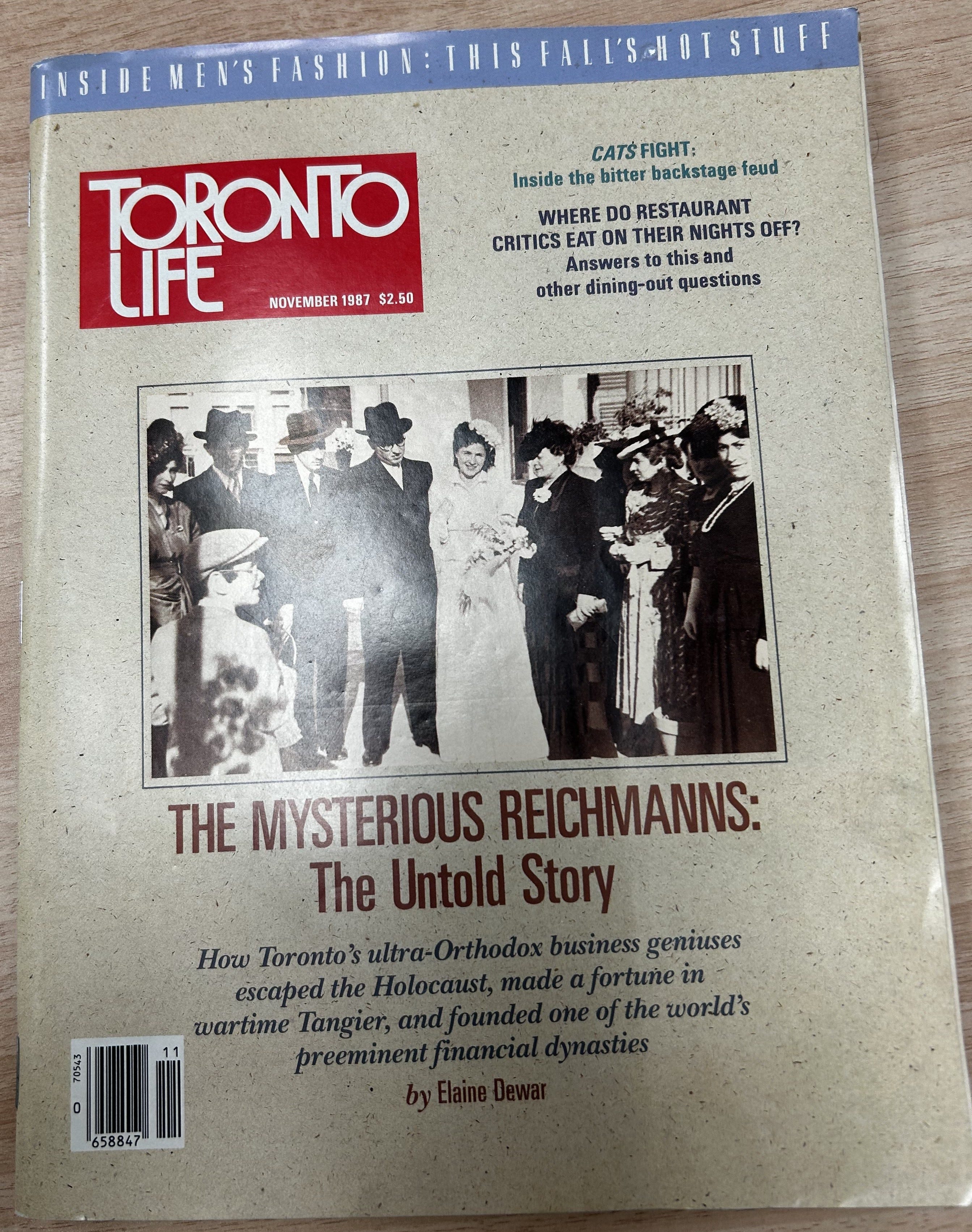
I filled 10 bankers boxes with the materials that went into the making of Oblivious, and then moved onto boxing up other documents, including some early essays I found by a teenage Elaine Landa where her voice and vocation was already evident. But what I’ve been thinking about since I located them was approximately a foot of documents tied to the Reichmann trial that resulted from her November 1987 Toronto Life profile “The Mysterious Reichmanns: The Untold Story.” This resulted in the Reichmann’s suing Elaine and Toronto Life, as I’ve heard more than one commentator say, into the stone age, costing her a book deal with Random House worth, if memory serves, $60,000, an estimated $250,000 in other lost revenue, the destruction of years of work, damage to her reputation, and an inhuman amount of stress. Lesser mortals, which means almost all of us, would have crumpled under the weight of it all, as was no doubt expected of Elaine. And yet in these surviving documents, and in the supreme court dispositions and typescripts, which must total close to 800 pages, you can see Elaine fighting back and continuing to kick against the pricks, refusing to give up her sources, maintaining her dignity and fighting for her profession and her own professional life. Sitting down in that cold and increasingly bare office, I couldn’t help but cheer her on forty years after the fact. I felt such an appreciation for how she conducted herself, not just for herself but for all of us. And though almost no one under a certain age remembers this trial or knows of its significance, what Elaine endured helped to change the shape of libel law in this country and made it safer for writers to do the work that they needed to get to the truth, and, as Elaine believed, to afflict the comfortable and comfort the afflicted.
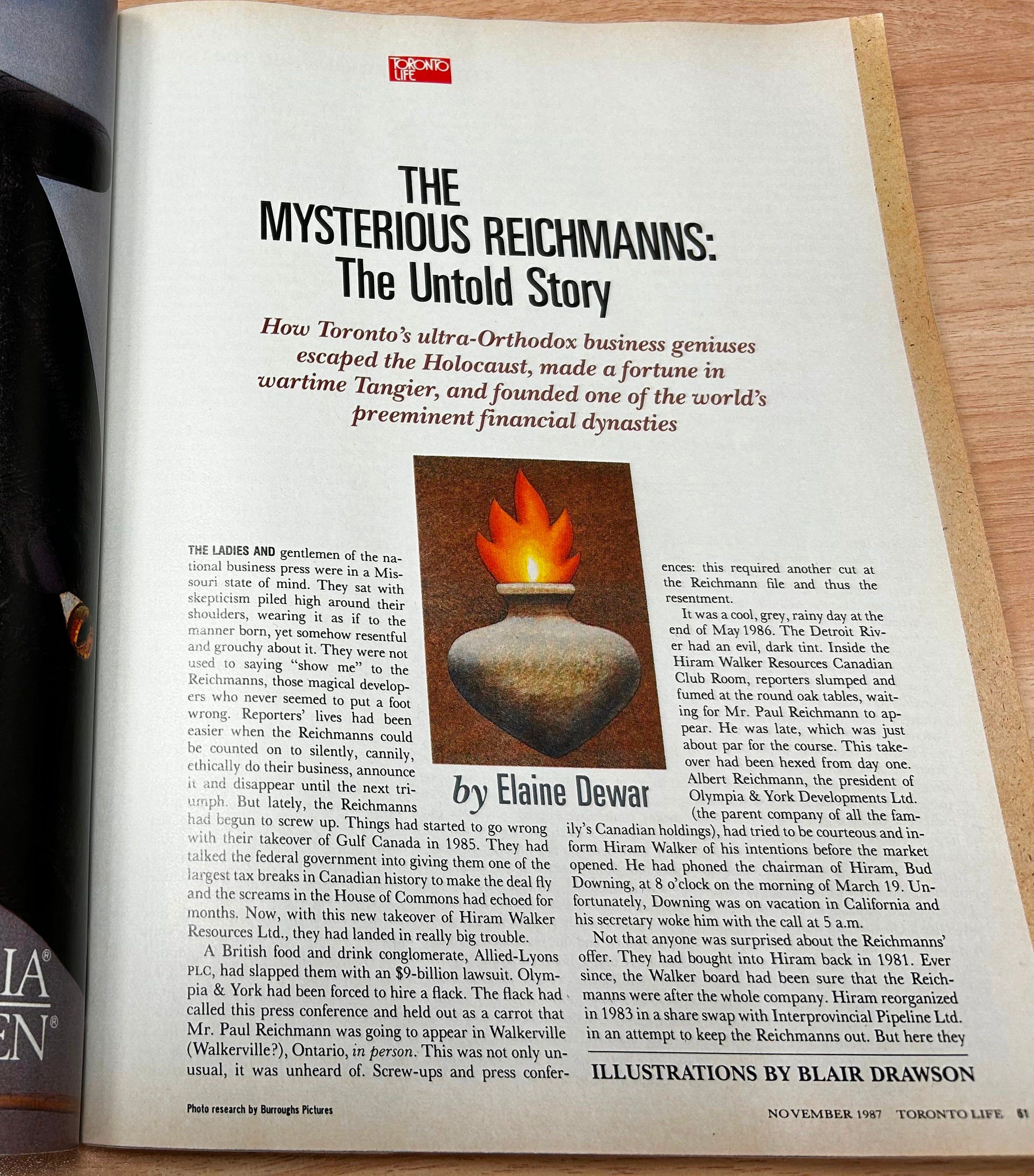
Among the notes I found was a request she made for me to have Mark Bourrie read her manuscript for libel when it was finished. So I sent a note off to Mark about it, forgetting that at that moment he was receiving the Pierre Berton Award from the Governor General. He gave a speech at its reception that he’s just posted on his own excellent Substack, which you can read here, but which I will selectively quote from below because it ties into something I’ve been thinking about since finding those files in Elaine’s office:
I want to talk about the fact right now we are in the midst of a revolution. Anybody who chooses to ignore it is simply going to find that out later. This is “elbows up” time in Canada. You would not know it from our policy-setters, who have let our country’s publishing and historic story-telling wither. We will be celebrating at the Canadian Museum of History tomorrow. Not everyone in the building will be happy—67 people in that organization have been told they are going to lose their jobs because of federal cuts.
. . .
I would like to be able to do more advocacy. We need to find ways to get the word out about our books. We need to fix the problems with the Copyright Act that, effectively, gave schools the “right” to take our work without paying. And we need to have a funding system that takes the financial risk of producing public history off the shoulders of families like mine.

The problem, of course, is that it has always been thus, at least when it comes to the cultural life of this country. Change has always been dependent on individuals, families, or small groups who resist the powerful or the indifferent and push forward despite the very real costs of doing so. I don’t anticipate at this moment that we’re in for substantial change for the better, however much I wish it were otherwise. Mark Carney may have quoted Thucydides and Václev Havel in his Davos speech, but almost a year into his leadership of the country I don’t think I’ve yet heard him say anything in defence of Canadian culture. If we’re going to improve things, we’ll have to take matters into our own hands, and this is why the examples of people like Elaine Dewar and Mark Bourrie (and so many of my small press publishing colleagues) mean so much to me at the moment. It’s difficult, it’s impossible, but they carry on. Which reminds me of a quote I first read on Derek Weiler’s arm, taken from an Irish writer I’ve since grown to love.
You must go on. I can't go on. I'll go on.
Greg Kelly, CBC Ideas producer, was in town yesterday to give a speech to the University of Windsor’s Humanities Research Group. Titled “Quiet Piggy: Private Codes as Public Discourse,” it was about the breakdown between the private and public and the hijacking of so-called authentic expression in the service of authoritarianism. During his conclusion he spoke of the necessity of action as a form of faith. There’s no guarantee that what we do will make any difference, though we know quite clearly what the consequences of our inaction are. It is through the slow accretion of our efforts, hopefully alongside others, that things change. This is a faith I can accept as my own. Perhaps it’s the remaining glow from my Italian sojourn, but I remain hopeful that we can continue to nudge the cultural needle in the right direction. After all, what choice do we have?
Dan Wells,
Publisher
In good publicity news:
Benbecula by Graeme Macrae Burnet was featured in the Historical Novels Review: “While Benbecula is a tragic story of murder, the empathy that the author feels for his characters and the circumstances that they’re living in is beautifully expressed . . . Consider this reader fully engaged by Benbecula.”
Smash & Grab by Mark Anthony Jarman was reviewed in Quill & Quire: “Jarman packs more into his sentences than any half dozen other authors combined . . . [Smash & Grab’s] cumulative riches are plentiful and unique to one of the most invigorating and unconventional writers of short fiction around.”
On Sports by David Macfarlane was reviewed in The Seaboard Review: “An authentic and resonant read, On Sports should appeal to sports fans who have had their misgivings about sport and where it’s headed, though anyone interested in sports more generally might enjoy reading about Macfarlane’s experiences, his emotional connections to sport, and his philosophical musings about its pros and cons.”
Precarious: The Lives of Migrant Workers by Marcello Di Cintio was reviewed by Anne Logan on CBC’s The Homestretch.
The Passenger Seat by Vijay Khurana is a shortlisted contender in The Tournament of Books! Will Vijay win the Rooster? We certainly hope so!
You cannot hear me out in B.C., in between the Monashees and Selkirk Mountains, but I am cheering you onward, Dan Wells. Elaine Dewar was everything a great investigative truth-telling journalist should be and kudos to you for salvaging her papers and making sure they go to the right place(s). Thanks also for kicking our feds in the slats for the continued rip-off of living writers' work in our educational tiers where there are many more votes than can be counted for those of us who provide the free "content".
Bravo!